
Solve vs resolve is a common English comparison because the two verbs are closely related. Both can describe taking action to deal with something difficult, but they are not always interchangeable.
The easiest distinction is this: solve usually means finding the answer to a problem, while resolve usually means dealing with a problem, conflict, disagreement, or difficult situation until it is settled.
For example, you solve a math problem, but you usually resolve a disagreement. You might solve a puzzle, but you resolve a dispute.
The difference becomes especially useful in professional, academic, and everyday English. Choosing the right verb can make your writing more precise and natural.
In this guide, you’ll learn exactly how solve vs resolve works, including their meanings, grammar, pronunciation, common collocations, formal usage, real-life examples, mistakes, and a simple memory trick.
Quick Answer
Solve means to find an answer or solution to a problem, question, puzzle, or mystery.
Resolve means to settle, fix, or bring an issue, conflict, disagreement, or difficult situation to an end.
Quick rule: You generally solve problems and puzzles, but resolve conflicts, disputes, issues, and disagreements. However, there is some overlap when problem or issue refers to a situation that needs to be dealt with.
Solve vs Resolve: Side-by-Side Comparison
| Feature | Solve | Resolve |
|---|---|---|
| Basic meaning | Find an answer or solution | Settle or deal with something |
| Main idea | Discover the solution | Bring an issue to a satisfactory conclusion |
| Part of speech | Verb; also has noun form solution, but solve itself is primarily a verb | Verb; also related to resolution |
| Pronunciation | /sɑːlv/ in many US varieties; /sɒlv/ in many UK varieties | /rɪˈzɑːlv/ in US English; /rɪˈzɒlv/ in many UK varieties |
| Common objects | Problem, puzzle, mystery, equation, question, crime | Conflict, dispute, disagreement, issue, matter, crisis |
| Typical focus | Answer or solution | Settlement or conclusion |
| Formality | Neutral; common in all kinds of English | Neutral to formal; especially common in professional contexts |
| Everyday use | Very common | Very common |
| Academic use | Very common in mathematics, science, research, analysis | Common in arguments, research issues, policy, and disputes |
| Business use | Solve a technical or practical problem | Resolve a complaint, conflict, issue, or dispute |
| Can they overlap? | Yes, with some nouns such as problem and issue | Yes, with some nouns such as problem and issue |
| Usually preferred with puzzles | Solve | Usually not resolve |
| Usually preferred with conflicts | Usually not solve | Resolve |
| Word family | solution, solvable, unsolved | resolution, resolute, resolvable |
| Simple memory clue | Solve = find the answer | Resolve = settle the situation |
What Does Solve Mean?
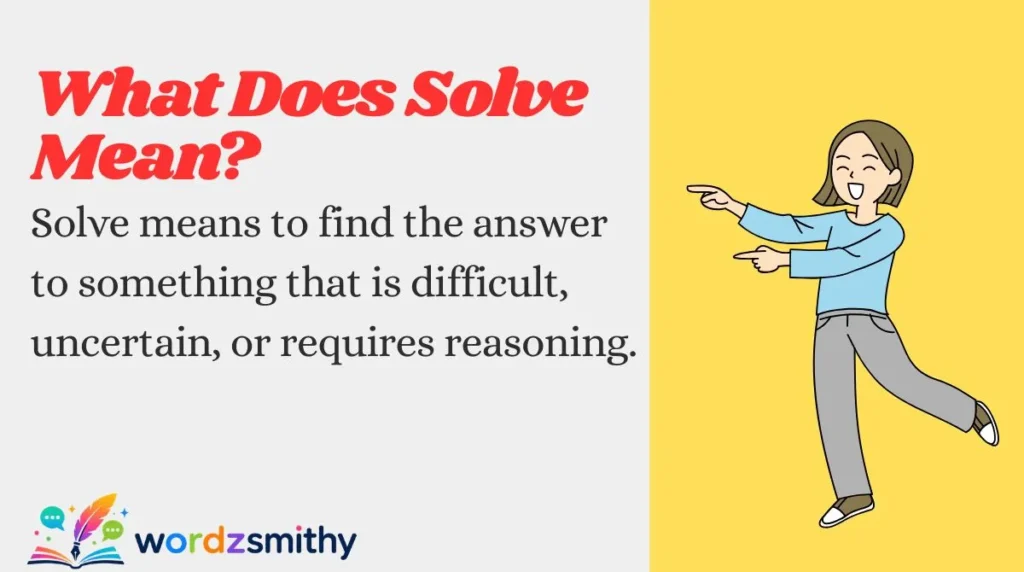
Solve means to find the answer to something that is difficult, uncertain, or requires reasoning.
It is especially common when there is a specific answer, method, explanation, or solution to be discovered.
You can solve:
- a math problem
- an equation
- a puzzle
- a riddle
- a mystery
- a crime
- a technical problem
- a logical problem
- a question
- a challenge
Consider these examples:
I need to solve this equation.
Can you solve this puzzle?
The detective solved the mystery.
In each case, the focus is on finding the answer or solution.
The Core Meaning of Solve
The central idea behind solve is:
There is something to figure out, and you discover how to answer or fix it.
This does not necessarily mean that the problem is easy. In fact, solve often suggests careful thinking, investigation, calculation, or analysis.
A scientist might solve a difficult research problem. A programmer might solve a software bug. A student might solve a mathematical equation. A detective might solve a crime.
The situations are different, but the underlying idea remains the same: find the solution.
Grammar of Solve
Solve is a regular transitive verb.
Common patterns include:
solve + noun
She solved the problem.
solve + possessive + noun
He solved his technical problem.
solve + question
The study may solve an important question.
solve + problem + by + -ing
We solved the issue by changing the system.
The verb can appear in different tenses:
- Present: I solve problems.
- Present continuous: I am solving the problem.
- Past: I solved the problem.
- Present perfect: We have solved the problem.
- Future: They will solve the problem.
Solve in Professional English
In business and technical writing, solve is particularly useful when the organization is looking for a practical answer.
For example:
Our engineers solved the software problem.
The new system solves several operational problems.
We need to solve the customer’s technical issue.
However, when the situation involves people disagreeing or a dispute between parties, resolve is often the more natural choice.
Compare:
The manager solved the disagreement.
The manager resolved the disagreement.
The second sentence sounds more natural because a disagreement is normally settled, rather than having an answer discovered like a puzzle.
Solve in Academic English
Solve is especially common in mathematics, computer science, physics, chemistry, logic, and other analytical fields.
Examples include:
Students must solve five equations.
Researchers are trying to solve a complex scientific problem.
The algorithm solves the optimization problem efficiently.
In these contexts, solve often refers to determining an answer through reasoning, calculation, experimentation, or an established method.
Solve in Everyday English
You will also hear solve in ordinary conversation:
We need to solve this parking problem.
I’ll solve it somehow.
Don’t worry. We’ll solve the problem together.
It can describe anything from a simple practical difficulty to a major technical challenge.
What Does Resolve Mean?
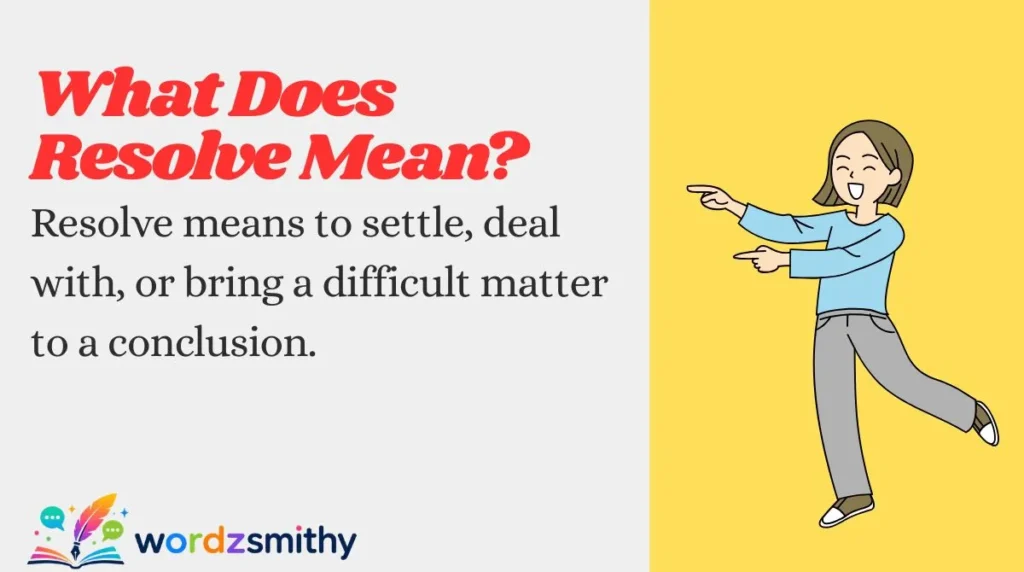
Resolve means to settle, deal with, or bring a difficult matter to a conclusion.
It is strongly associated with situations involving:
- conflicts
- disputes
- disagreements
- complaints
- issues
- misunderstandings
- crises
- legal matters
- negotiations
- difficult situations
For example:
They resolved their disagreement.
The company resolved the customer’s complaint.
We need to resolve this issue quickly.
The focus is usually not on discovering a hidden answer. Instead, the focus is on settling or bringing the matter to an end.
The Core Meaning of Resolve
The central idea behind resolve is:
Something is unsettled, and you take action to settle it.
Imagine two employees have a disagreement. There may not be one objectively correct answer waiting to be discovered. The people involved need to communicate, negotiate, compromise, or make a decision.
That is a situation you resolve.
Grammar of Resolve
Resolve is also a regular transitive verb.
Common patterns include:
resolve + noun
The manager resolved the issue.
resolve + conflict
The mediator helped resolve the conflict.
resolve + dispute
The two companies resolved the dispute.
resolve + to + verb
This is a different meaning of resolve: to make a firm decision.
She resolved to improve her writing.
Here, resolve means decide firmly, not settle a problem.
That distinction is important because resolve has more than one related meaning.
Resolve in Professional English
Resolve is extremely common in business communication because professional environments often involve issues, complaints, disputes, misunderstandings, and operational matters.
For example:
We are working to resolve the issue.
Our support team resolved the customer’s complaint.
The two departments met to resolve the dispute.
Please contact us if the problem has not been resolved.
Notice how resolve can sound especially appropriate when the goal is to bring a matter to a satisfactory conclusion.
Resolve in Academic English
Academic writing can use resolve when discussing questions, debates, contradictions, uncertainties, or problems that require clarification.
For example:
Further research may help resolve the disagreement between the two theories.
The experiment resolved an important uncertainty.
The researchers developed a method to resolve the apparent contradiction.
In academic contexts, resolve can sound more precise when the issue involves uncertainty, disagreement, or contradiction rather than a straightforward calculation.
Resolve in Everyday English
You can use resolve in everyday speech, although sort out, fix, and deal with may sometimes sound more casual.
We need to resolve this misunderstanding.
Have you resolved the problem with your neighbor?
They finally resolved their argument.
Because resolve can sound somewhat more formal than fix, it is particularly useful in professional or carefully written English.
Solve vs Resolve: The Key Difference
The most useful way to understand solve vs resolve is to focus on what happens to the problem.
Solve focuses on the answer
When you solve something, you usually discover the answer or determine a solution.
solve a puzzle
solve an equation
solve a mystery
solve a crime
solve a mathematical problem
Resolve focuses on settlement
When you resolve something, you usually settle it, remove the difficulty, or bring it to a conclusion.
resolve a conflict
resolve a dispute
resolve a disagreement
resolve a complaint
resolve an issue
But “Problem” Can Work With Both
This is where the comparison becomes more interesting.
Both verbs can occur with problem:
We need to solve the problem.
We need to resolve the problem.
Both can be grammatical, but the emphasis can differ.
Solve the problem often emphasizes finding the answer or solution.
Resolve the problem often emphasizes dealing with the situation and bringing it to a satisfactory end.
For many everyday situations, solve the problem is the more straightforward choice. In business or formal contexts, resolve the problem can also be completely natural.
The same overlap occurs with issue.
We need to solve this issue.
We need to resolve this issue.
The second is particularly common in professional communication.
Solve vs Resolve: When Should You Use Each?
A simple decision process can make the choice easy.
Use Solve When You Are Looking for an Answer
Choose solve when the task involves reasoning, calculation, investigation, or finding an answer.
Examples:
- solve an equation
- solve a puzzle
- solve a riddle
- solve a mystery
- solve a crime
- solve a technical problem
Use Resolve When You Are Settling Something
Choose resolve when the situation involves settlement, agreement, clarification, negotiation, or bringing an ongoing matter to an end.
Examples:
- resolve a conflict
- resolve a dispute
- resolve a disagreement
- resolve a complaint
- resolve an issue
- resolve a misunderstanding
Use Either When the Noun Allows Both
Some nouns naturally work with both verbs, especially:
- problem
- issue
- difficulty
- question
- situation
The best choice depends on the intended meaning and context.
Grammar: Solve vs Resolve
Both solve and resolve are verbs, and both are normally used transitively when they mean dealing with something.
That means they usually take a direct object.
We solved the problem.
We resolved the dispute.
You would not normally say:
We solved.
or:
We resolved.
without additional context.
Verb Forms
Both are regular verbs.
| Form | Solve | Resolve |
|---|---|---|
| Base form | solve | resolve |
| Third-person singular | solves | resolves |
| -ing form | solving | resolving |
| Past tense | solved | resolved |
| Past participle | solved | resolved |
Examples:
She solves difficult problems quickly.
She is solving the problem now.
She solved it yesterday.
She has solved the problem.
And:
He resolves customer complaints.
He is resolving a dispute.
He resolved the issue.
He has resolved the matter.
Noun Forms
The related nouns are different:
solve → solution
We found a solution.
resolve → resolution
We reached a resolution.
This provides another useful clue.
A solution is an answer or method for dealing with a problem.
A resolution is often a settlement, decision, or final outcome.
Pronunciation: Solve vs Resolve
The words are easy to distinguish when spoken.
Solve has one syllable:
solve
Resolve has two syllables:
re-SOLVE
The stress in resolve falls on the second syllable.
In many varieties of English, solve has a vowel sound similar to the vowel in involve, although pronunciation varies between accents.
Do not confuse resolve with result or revolve. The pronunciation and meanings are different.
Common Collocations With Solve
Learning common word combinations is often more useful than memorizing a dictionary definition.
Common collocations include:
- solve a problem
- solve a puzzle
- solve a mystery
- solve a crime
- solve an equation
- solve a question
- solve a challenge
- solve a technical problem
- solve a difficult problem
- solve a practical problem
- solve a complex issue
Examples:
The software helped us solve the problem.
Can you solve this riddle?
Detectives worked for months to solve the crime.
Common Collocations With Resolve
Common combinations with resolve include:
- resolve a conflict
- resolve a dispute
- resolve a disagreement
- resolve an issue
- resolve a complaint
- resolve a misunderstanding
- resolve a matter
- resolve a crisis
- resolve a legal dispute
- resolve a technical issue
- resolve a customer complaint
- resolve differences
Examples:
The mediator helped resolve the conflict.
We are trying to resolve the issue.
The company promised to resolve the complaint.
These collocations are useful because they show how native speakers naturally choose between the two verbs.
20+ Real-Life Examples of Solve vs Resolve
Everyday Conversation
1.
I can’t solve this puzzle.
The speaker needs to find the answer.
2.
Let’s resolve this misunderstanding before it gets worse.
The goal is to settle the situation.
3.
We need to solve the problem with the broken printer.
This focuses on finding a practical fix.
4.
They finally resolved their disagreement.
The disagreement has been settled.
Text Messages
5.
Can you help me solve this math problem?
Natural and direct.
6.
We should talk and resolve this issue.
The focus is on settling the issue.
7.
Don’t worry. We’ll solve it tomorrow.
Here, solve means find a practical answer.
School and Education
8.
Students were asked to solve ten algebra equations.
9.
The class tried to solve the mystery in the story.
10.
The teacher helped the students resolve a disagreement during the group project.
Notice the difference: equations and mysteries are solved, while a disagreement is resolved.
Business
11.
Our IT department solved the network problem.
12.
The manager resolved the customer’s complaint.
13.
We need to resolve the disagreement between the two teams.
14.
The engineers are working to solve the technical problem.
15.
The company has resolved the issue with the payment system.
Both verbs can appear in the same professional environment because they describe different kinds of action.
Email Writing
16.
We are working to resolve your issue as quickly as possible.
This is a common professional style.
17.
Our technical team has solved the problem and restored the service.
Here the team found and implemented the technical solution.
Professional Writing
18.
The investigation may help solve the underlying technical problem.
19.
The two parties agreed to resolve the dispute through negotiation.
20.
The new procedure was designed to solve recurring operational problems.
Academic Writing
21.
Researchers are attempting to solve a long-standing mathematical problem.
22.
The evidence helped resolve the apparent contradiction.
23.
Further experiments may resolve the uncertainty surrounding the results.
Social Media
24.
Sometimes talking is the best way to resolve a disagreement.
25.
We finally solved the problem after three hours!
These examples show why the two verbs should not be treated as perfect synonyms.
Common Mistakes With Solve and Resolve
Mistake 1: Using Resolve for a Puzzle
Wrong or unnatural:
Can you resolve this crossword puzzle?
Better:
Can you solve this crossword puzzle?
A crossword is a puzzle with answers to discover, so solve is the natural choice.
Mistake 2: Using Solve for a Dispute
Less natural:
The lawyers solved the dispute.
Better:
The lawyers resolved the dispute.
A dispute needs to be settled or brought to an end, so resolve fits better.
Mistake 3: Thinking Resolve Is Always More Formal
Some writers believe that resolve is simply a more sophisticated version of solve.
That is not quite right.
Resolve is not automatically a formal replacement for solve. The words have overlapping meanings, but their normal collocations differ.
You would still normally say:
solve an equation
rather than:
resolve an equation
Mistake 4: Assuming Problem Only Works With Solve
Both can be used.
We need to solve the problem.
We need to resolve the problem.
The first emphasizes finding a solution. The second emphasizes dealing with the matter and bringing it to a conclusion.
Mistake 5: Confusing Resolve With “Make a Decision”
Resolve also has the meaning to decide firmly.
She resolved to exercise more regularly.
This does not mean that she settled a conflict. It means she made a firm decision.
Compare:
She resolved the dispute.
Here, resolve means settle.
She resolved to change her approach.
Here, resolve means decide firmly.
Solve vs Resolve in Business English
Professional writers often need to choose between these verbs carefully.
Use solve when discussing:
- technical problems
- analytical problems
- mathematical challenges
- software bugs
- operational difficulties
- practical solutions
Use resolve when discussing:
- customer complaints
- disputes
- employee conflicts
- disagreements
- service issues
- misunderstandings
- outstanding matters
For example:
Our developers solved the software bug.
But:
Our customer-service team resolved the complaint.
A useful professional phrase is:
We are working to resolve the issue.
It is polite, neutral, and widely applicable.
Solve vs Resolve in Academic English
Academic writers should also consider the type of problem being discussed.
Use solve for problems that require an answer, calculation, method, or explanation:
The researchers developed a method to solve the equation.
Use resolve for uncertainty, contradiction, disagreement, or an unsettled matter:
The new evidence helped resolve the contradiction.
That distinction is not absolute. Academic writers may use either word with broad terms such as problem or question, depending on the intended meaning.
Is Solve or Resolve More Formal?
Neither word is inherently formal or informal.
Solve is extremely common in everyday English and formal writing alike.
Resolve is also standard English, but it often appears more frequently in professional, legal, diplomatic, administrative, and formal contexts because those fields commonly discuss disputes, issues, complaints, and negotiations.
For example:
Everyday:
Let’s fix this problem.
Neutral:
Let’s solve this problem.
Professional:
Let’s resolve this issue.
However, this does not mean resolve should replace solve everywhere.
Are Solve and Resolve Interchangeable?
No, not always.
They overlap when referring to broad problems or issues, but they are not interchangeable in every context.
You normally:
- solve a puzzle
- solve an equation
- solve a riddle
- solve a mystery
You normally:
- resolve a conflict
- resolve a dispute
- resolve a disagreement
- resolve a complaint
With broader nouns such as problem and issue, both may work depending on the meaning.
That is why simply memorizing “solve = problem” and “resolve = conflict” is useful as a starting point, but not the whole story.
US vs UK English
There is no major US-versus-UK usage difference between solve and resolve.
Both are standard in American and British English.
The main differences you may notice are related to pronunciation, accent, or individual style rather than a different grammar rule.
For example, both American and British speakers commonly say:
solve a problem
and:
resolve a dispute
So if you are writing for either audience, you do not need to choose one word based simply on whether your readers use American or British English.
Formal Writing and Style Guides
Standard English style resources such as Merriam-Webster, Cambridge Dictionary, Oxford Dictionary, and Collins Dictionary recognize solve and resolve as established English verbs with related but distinct meanings.
The AP Stylebook and Chicago Manual of Style do not create a special rule requiring writers to use one word instead of the other. Good usage depends primarily on meaning, context, and natural collocation.
The practical editorial rule is simple:
Choose the verb that accurately describes the action you mean.
If you mean find an answer, solve is usually right.
If you mean settle or bring a matter to a conclusion, resolve is usually right.
Memory Tricks for Solve vs Resolve
Here are several ways to remember the difference.
Memory Trick 1: Solve = Solution
Think:
SOLVE → SOLUTION
When you solve something, you find a solution.
solve a puzzle → find the solution
Memory Trick 2: Resolve = Resolution
Think:
RESOLVE → RESOLUTION
A resolution can mean a settlement or final decision.
resolve a dispute → reach a resolution
Memory Trick 3: Puzzle vs People
This is an especially easy rule:
Puzzles are solved. Conflicts are resolved.
If you are trying to figure something out, think solve.
If people or parties need to settle something, think resolve.
Memory Trick 4: Answer vs Agreement
Ask yourself:
“Am I looking for an answer?”
→ Solve
“Am I trying to reach a settlement?”
→ Resolve
Quick Decision Guide
When you’re unsure, ask these questions:
- Is there an answer to discover?
Use solve. - Is it a puzzle, equation, mystery, or riddle?
Use solve. - Is it a disagreement or conflict?
Use resolve. - Is it a dispute or complaint?
Use resolve. - Is it a broad problem or issue?
Either may work; consider the intended emphasis. - Does the sentence describe making a firm decision?
Use resolve in the sense of resolve to do something.
Frequently Asked Questions
Is it better to solve or resolve a problem?
Both can be correct, depending on context. Solve a problem usually emphasizes finding the answer or solution, while resolve a problem emphasizes dealing with it and bringing the situation to a satisfactory conclusion.
For ordinary problem-solving, solve a problem is often the most straightforward choice.
Should I solve or resolve an issue?
Both are possible, but resolve an issue is especially common in professional English.
For example:
We need to resolve this issue before Friday.
If you are emphasizing the process of finding the technical answer, solve may be better:
Our engineers need to solve the issue.
Do you solve a conflict or resolve a conflict?
The standard and more natural collocation is resolve a conflict.
The mediator helped resolve the conflict.
Solve a conflict may be understandable, but resolve a conflict is the stronger conventional choice.
Do you solve or resolve a mystery?
You normally solve a mystery.
The detective solved the mystery.
A mystery generally requires an answer or explanation to be discovered.
Do you solve or resolve a dispute?
You normally resolve a dispute.
The two companies resolved the dispute.
A dispute is something that parties settle rather than a puzzle that has one hidden answer.
Is “resolve” just a more formal word for “solve”?
No. The meanings overlap, but the words have different typical uses.
Solve is strongly associated with answers and solutions.
Resolve is strongly associated with settlement, conflicts, disputes, issues, and decisions.
Can “resolve” mean “decide”?
Yes.
She resolved to work harder.
In this construction, resolve to + verb means to make a firm decision.
He resolved to speak to his manager.
This is different from:
He resolved the disagreement with his manager.
Is “solve an issue” grammatically correct?
Yes.
Solve an issue is grammatically correct, particularly when the issue is treated as a problem requiring a solution.
However, resolve an issue is also correct and is extremely common in professional communication.
Which word should I use in professional emails?
If you are talking about a complaint, dispute, misunderstanding, or customer-service matter, resolve is often the best choice.
If you are describing a technical or practical problem that requires a solution, solve is often more natural.
For example:
We are working to resolve your complaint.
but:
Our technical team is working to solve the software problem.
Solve vs Resolve: A Final Practical Comparison
The distinction can be reduced to one simple contrast:
| If you mean… | Prefer |
|---|---|
| Find an answer | solve |
| Find a mathematical answer | solve |
| Figure out a puzzle | solve |
| Discover who committed a crime | solve |
| Explain a mystery | solve |
| Settle a disagreement | resolve |
| Settle a dispute | resolve |
| Deal with a complaint | resolve |
| Bring a conflict to an end | resolve |
| Clear up a misunderstanding | resolve |
| Deal with a broad issue | solve or resolve, depending on context |
| Make a firm decision | resolve to + verb |
Final Verdict
The best way to remember solve vs resolve is not to treat one as correct and the other as incorrect. Both are standard English verbs, but they normally describe different kinds of action.
Use solve when you need to find an answer or solution.
solve a puzzle
solve an equation
solve a mystery
solve a problem
Use resolve when you need to settle an issue or bring a difficult situation to a conclusion.
resolve a conflict
resolve a dispute
resolve a disagreement
resolve a complaint
resolve an issue
The most important point is that problem and issue can work with both verbs. In those cases, choose according to the meaning you want to emphasize.
If you’re figuring something out, think solve.
If you’re settling something, think resolve.
That small distinction will make your English more precise, especially in business writing, academic work, professional emails, and everyday conversation.

Evan Bennett is a language enthusiast who writes simple, clear guides about word meanings, slang, phrases, and everyday expressions.
He helps readers understand modern language quickly with easy explanations and useful examples.